My research combines astrodynamics, numerical optimization, and economic analysis to assess the feasibility of space missions, with a focus on asteroid and lunar resources. I also have experience in satellite constellation analysis. I hold an M.Sc. in Aerospace Engineering from K. N. Toosi University of Technology, where my thesis focused on asteroid-mission design and space-resource feasibility.
Research interests: Astrodynamics and mission design; flight dynamics and control; aerospace systems design; computational modeling and optimization.
Publications
Published papers and ongoing manuscripts
Published Journal Articles
2026
Critical-Point n-Fold Coverage Evaluation for Continuous Coverage in Mega-Constellation Design
A geometric coverage evaluator coupled to particle swarm optimization for sizing constellations that maintain simultaneous access to one or more satellites.
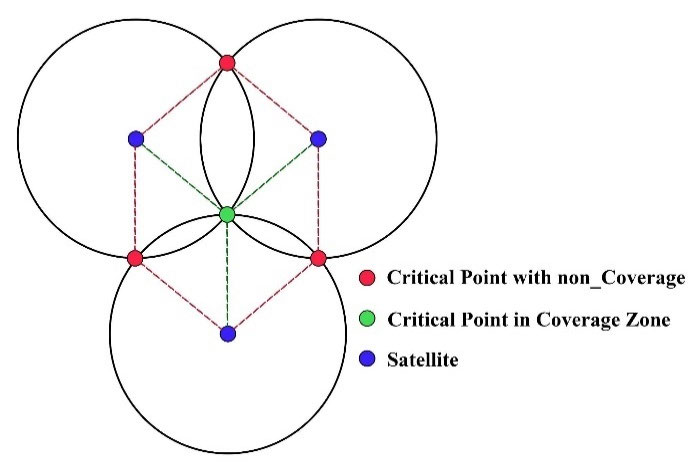
Continuous n-fold coverage means keeping every location in a target region visible to at least n satellites throughout the evaluation period. This study concentrates the coverage calculation at footprint-boundary intersections, where gaps can first emerge. Local satellite directions and contributions from overlapping footprints determine the coverage count at each critical point.
Geometric evaluation
Spherical footprint intersections and local azimuth geometry replace dense, uniformly spaced ground samples.
Constellation design
Particle swarm optimization varies satellite count, orbital planes, phasing, and inclination to find feasible Walker–Delta configurations.
Verification
Selected designs are re-evaluated with the grid point approach over one week. Execution times are compared with grid and polygon evaluators in the same computing environment.
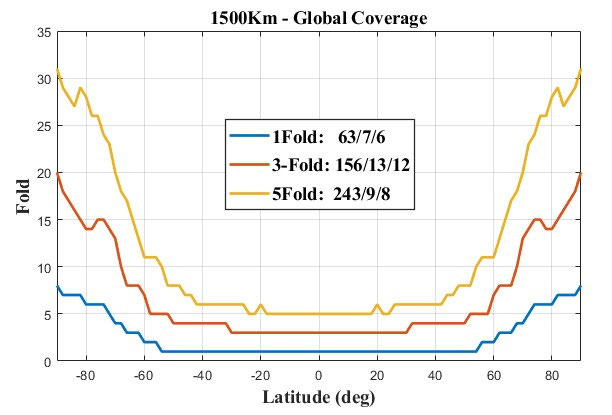
Reported result. In the tested cases, the critical-point evaluator reduced execution time while retaining the coverage decisions of the comparison methods. The examples below show how increasing simultaneous coverage requirements changes the feasible constellation size.
Global coverage example · 1,500 km altitude · 15° minimum elevation
1-fold coverage
63 satellites
3-fold coverage
156 satellites
5-fold coverage
243 satellites
Reported feasible designs from the optimization study; these counts are specific to the stated assumptions and are not proven global minima.
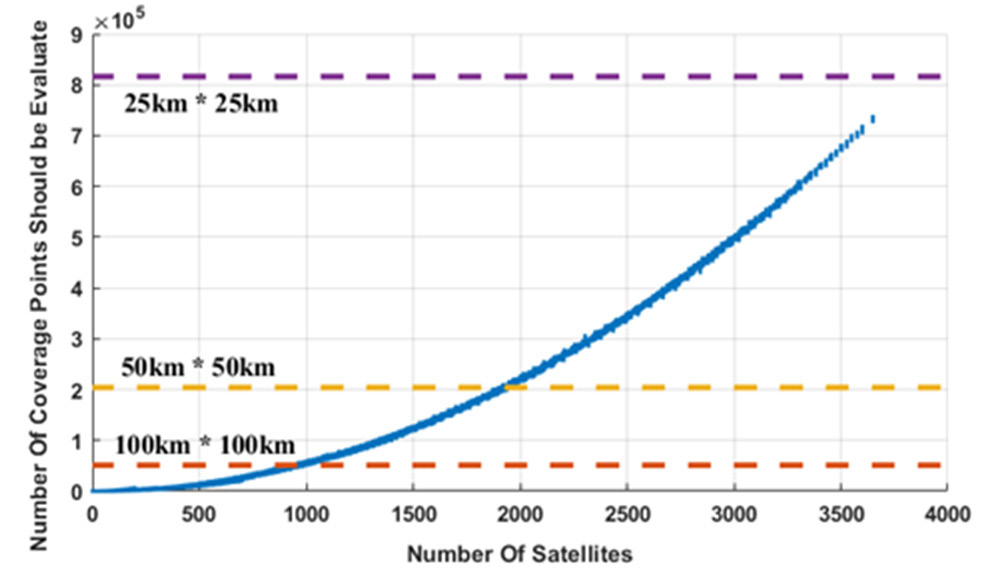
Enlarge figure ↗Fig. 5 · Critical-point concept. Footprint intersections identify locations at risk of losing coverage. The schematic distinguishes covered points in green and uncovered points in red.Enlarge figure ↗Fig. 14 · Coverage requirements. Coverage by latitude for optimized configurations at 1,500 km. The equatorial region sets the lowest coverage level in these Walker–Delta examples.Enlarge figure ↗Fig. 15 · Evaluation effort. Critical-point counts vary with constellation size, while grid counts depend on the chosen spatial resolution. This figure compares evaluation-point counts, not measured runtime.
Scope: the numerical study assumes symmetric Walker–Delta constellations, a spherical Earth, circular footprints, and sufficient footprint overlap within the target region. Asymmetric configurations require time propagation and further assessment.
01
2024
Economic Analysis of Exploitation of Lunar Resources
Ebrahim Amiri, Masoome Khani Chamani, Mahdi Jafari-Nodoshan, Sajjad Ghazanfarinia, and Masoud Khoshsima. Journal of Space Science and Technology, 17(3), 1–14. [in Persian]
Uses economic valuation, fuzzy analysis, and sensitivity analysis to compare candidate lunar materials and the conditions under which exploitation may become viable. Connects commercial feasibility with sustainable exploration.
Challenges of Asteroid Mining from Techno-Economic and Legal Points of View
Ebrahim Amiri and Mahdi Jafari-Nadoushan. Journal of Technology in Aerospace Engineering, 5(1), 1–13. [in Persian]
Examines accessible near-Earth asteroids from technical, economic, and legal perspectives, with particular attention to regulatory uncertainty and investment risk.
Conceptual Design and Flight Simulation of Small Satellite Payload Recovery System Using an Autonomous Guided Parafoil Based on COTS
Niki Sajjad, Ali Zeinalian, Alireza Amirkhani, Zahra Arabtelgerd, and Ebrahim Amiri. 72nd International Astronautical Congress, Dubai. IAC-21,A6,IP,20,x66306.
Presents the conceptual design, trajectory planning, and six-degree-of-freedom simulation of a 2 kg autonomous guided parafoil payload-recovery system.
Multi-Objective Optimization of Near-Earth Asteroid Missions for GEO Refueling Logistics
Ebrahim Amiri and Mahdi Jafari-Nadoushan. Engineering Applications of Artificial Intelligence. 2026. Under review.
An integrated framework for comparing asteroid-water supply missions through target screening, trajectory optimization, mass budgeting, and mission economics.
Journal manuscript · under reviewFull text not yet public
Overview & Selected Figures
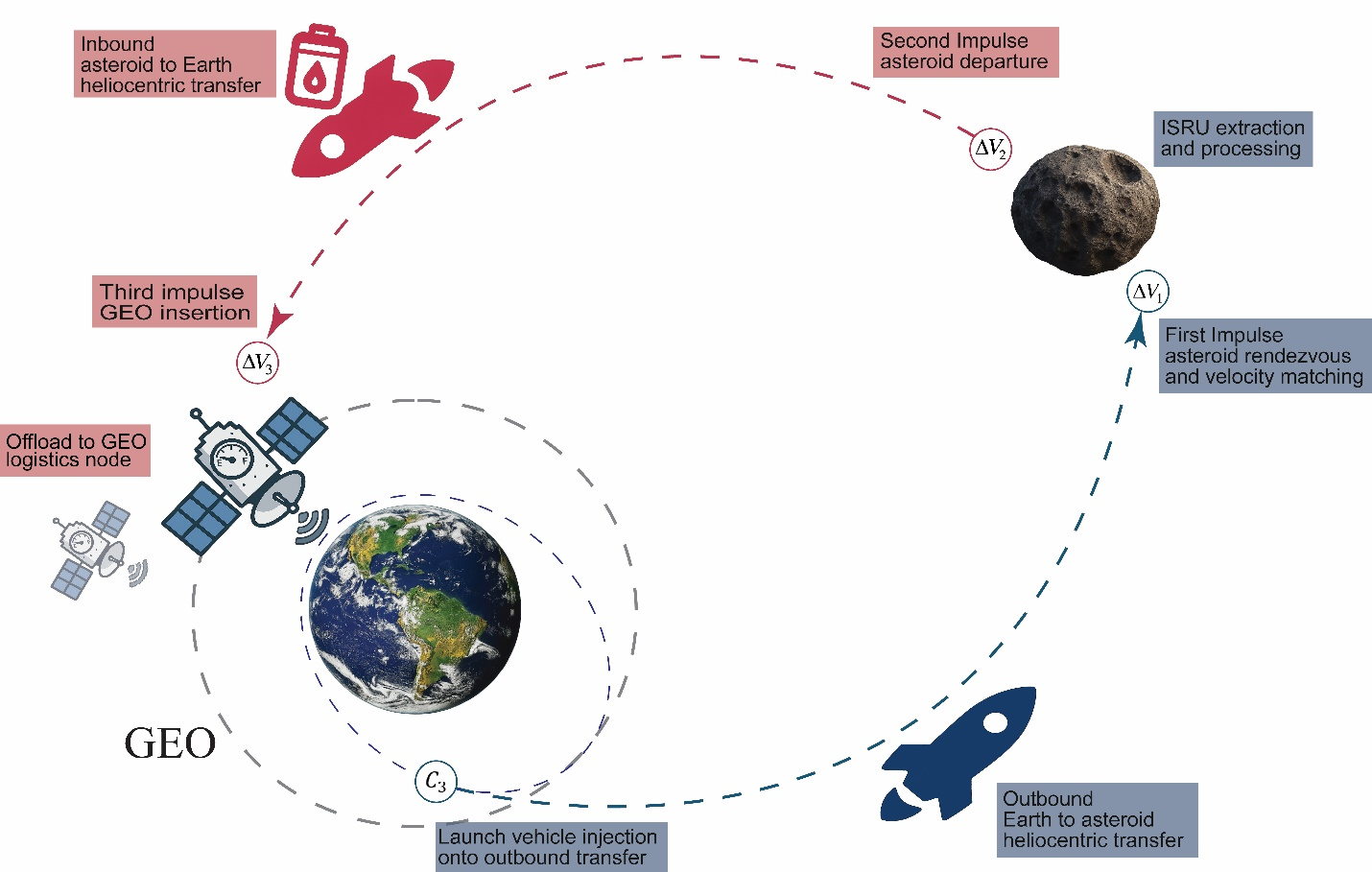
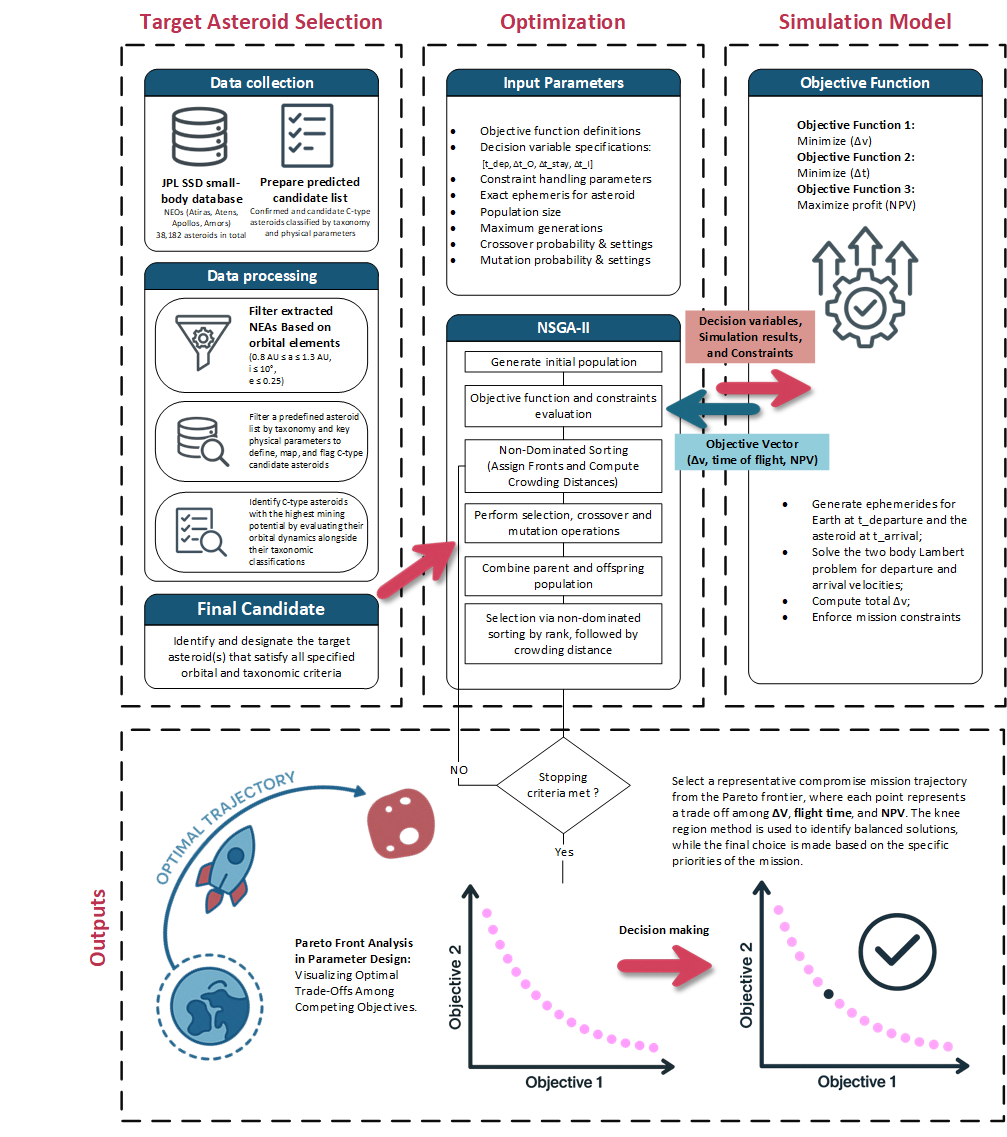
This study examines near-Earth asteroids as potential sources of water for future refueling infrastructure in geostationary Earth orbit (GEO). It combines orbital and compositional screening, JPL HORIZONS ephemerides, impulsive Lambert transfers, resource-processing assumptions, and discounted cash-flow analysis in one decision-support workflow.
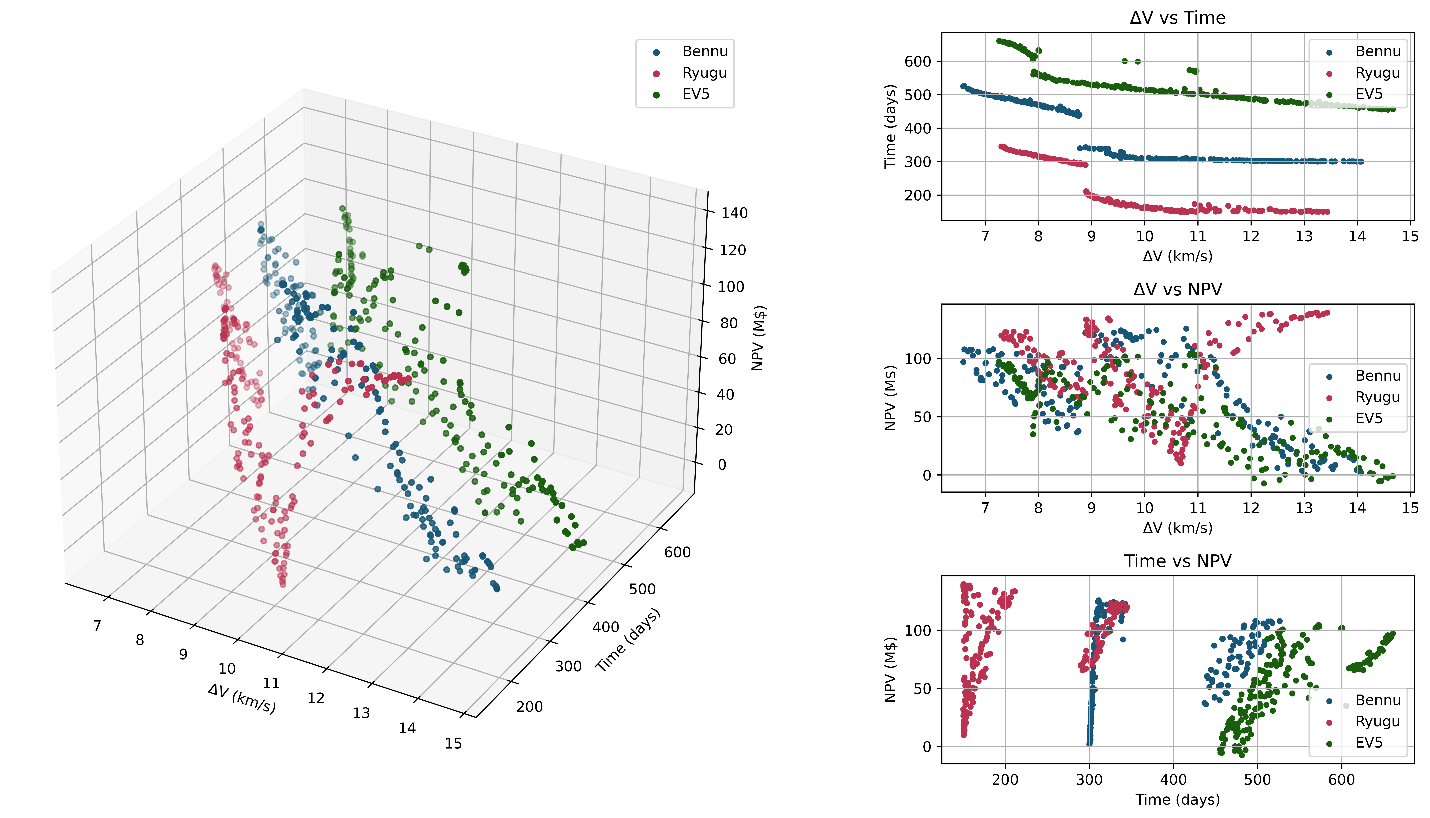
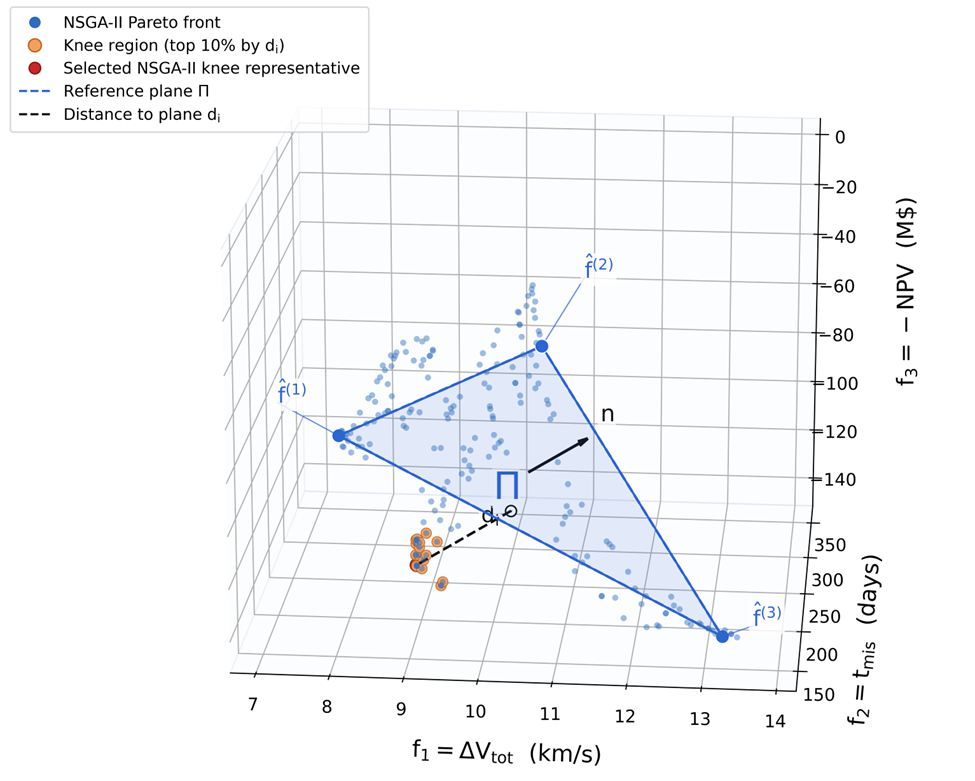
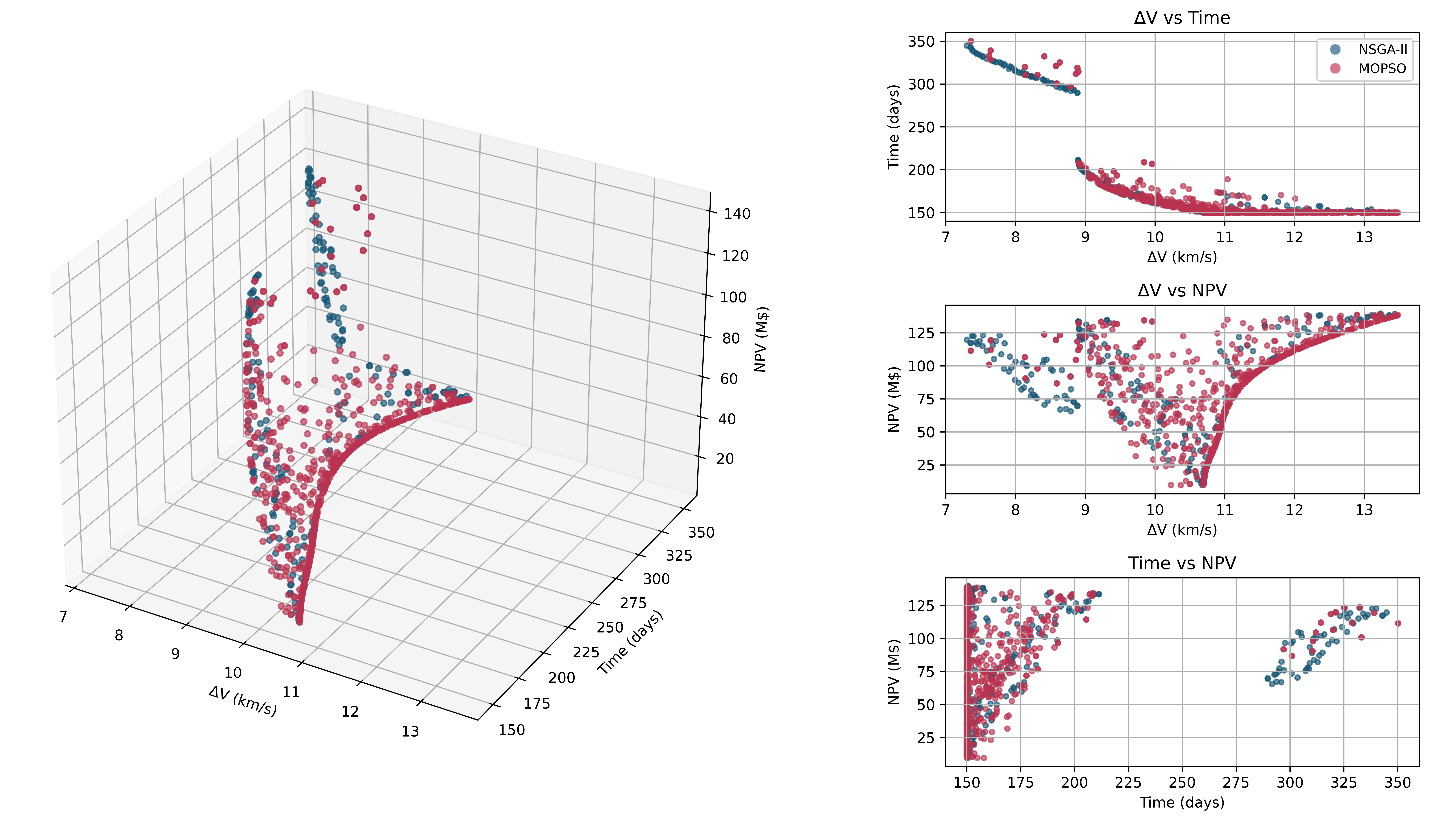
An NSGA-II optimizer varies departure date, outbound flight time, asteroid stay time, and return flight time to balance total spacecraft ΔV, mission duration, and net present value (NPV). Bennu, Ryugu, and 2008 EV5 are evaluated under common technical and economic assumptions.
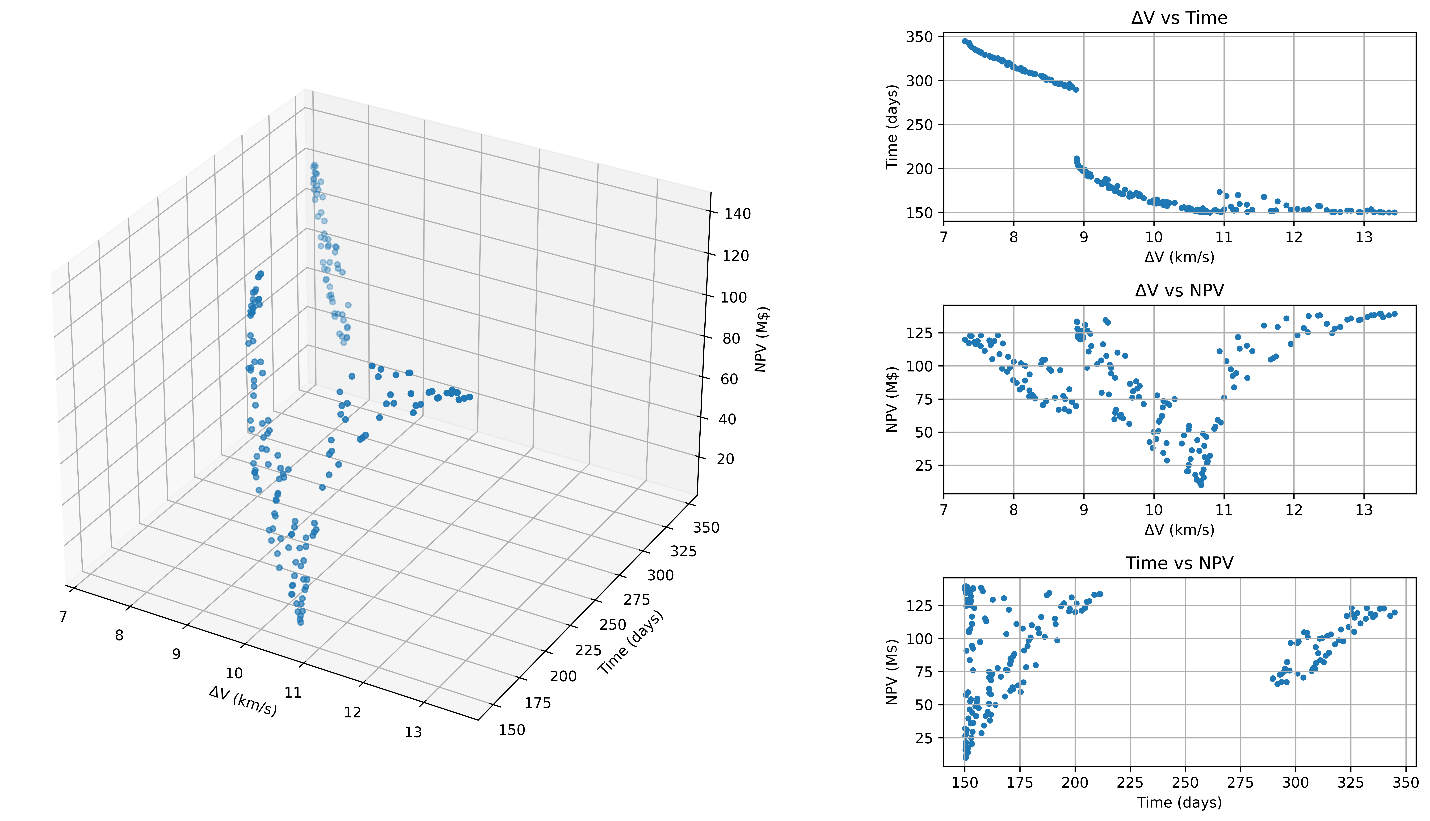
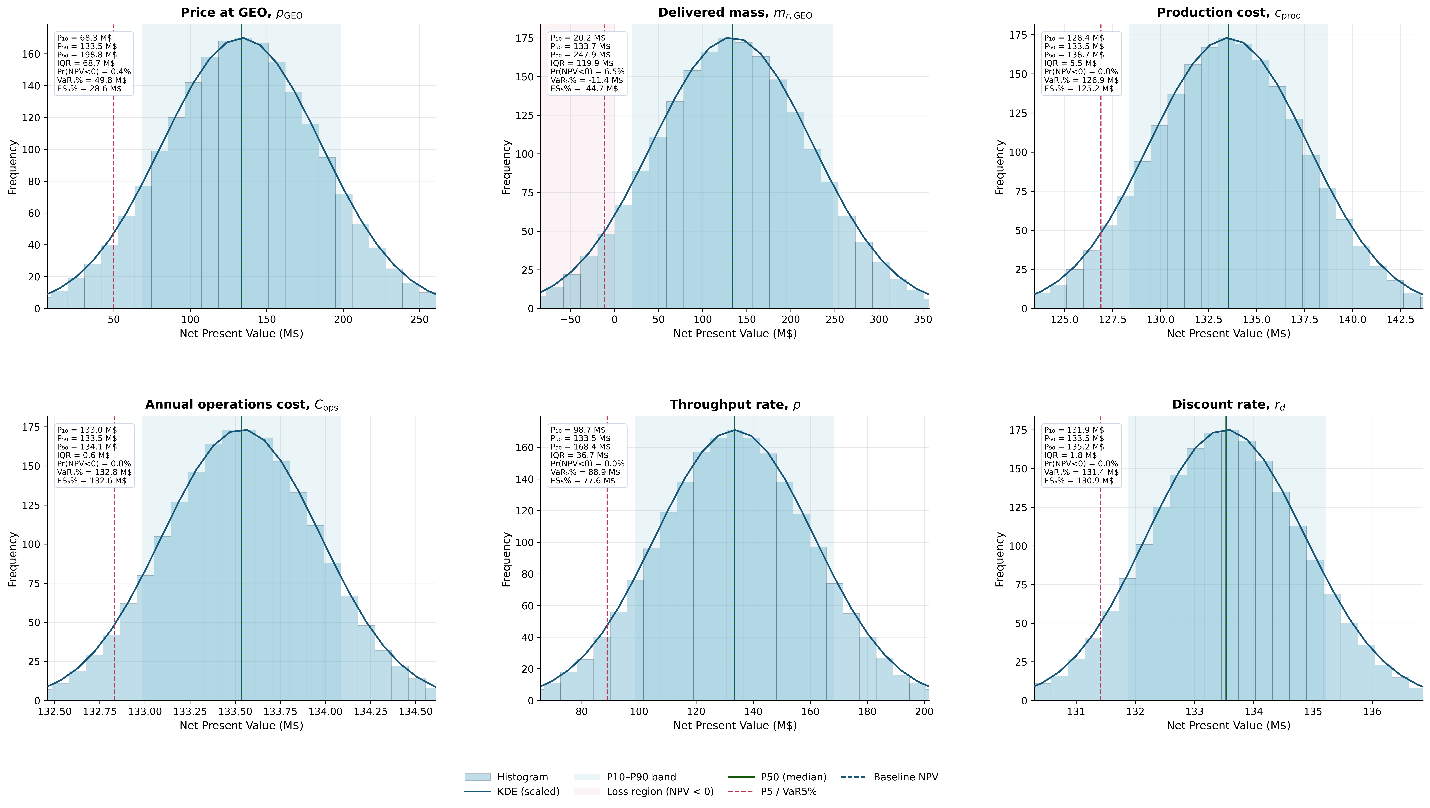
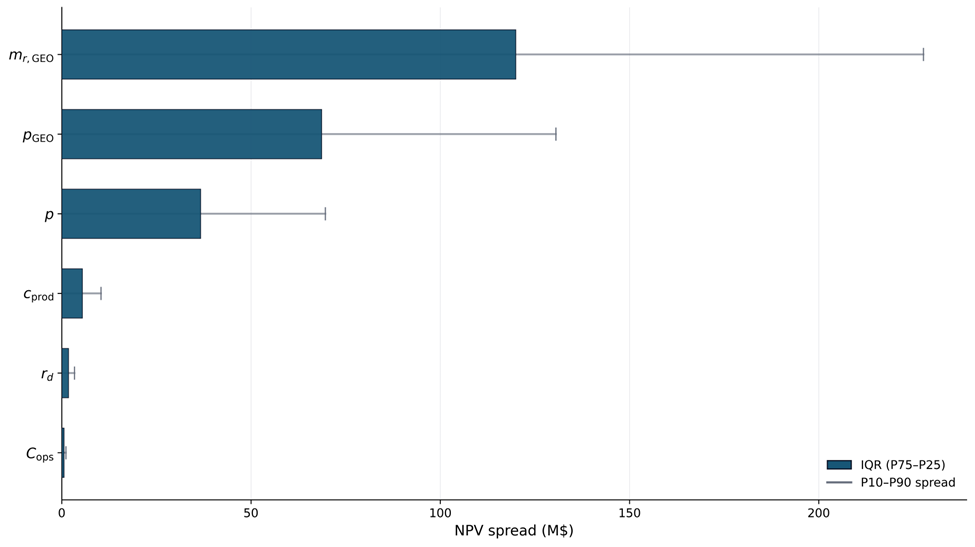
Key finding. Under the baseline assumptions, Ryugu offers the broadest economically attractive region of the trade space. A representative knee-region solution balances maneuver demand, duration, and return, while sensitivity analysis identifies delivered water mass, GEO selling price, and extraction throughput as the main economic drivers.
My contribution
Methodology, formal analysis and investigation, and the original manuscript draft, as recorded in the authorship statement.
Method checks
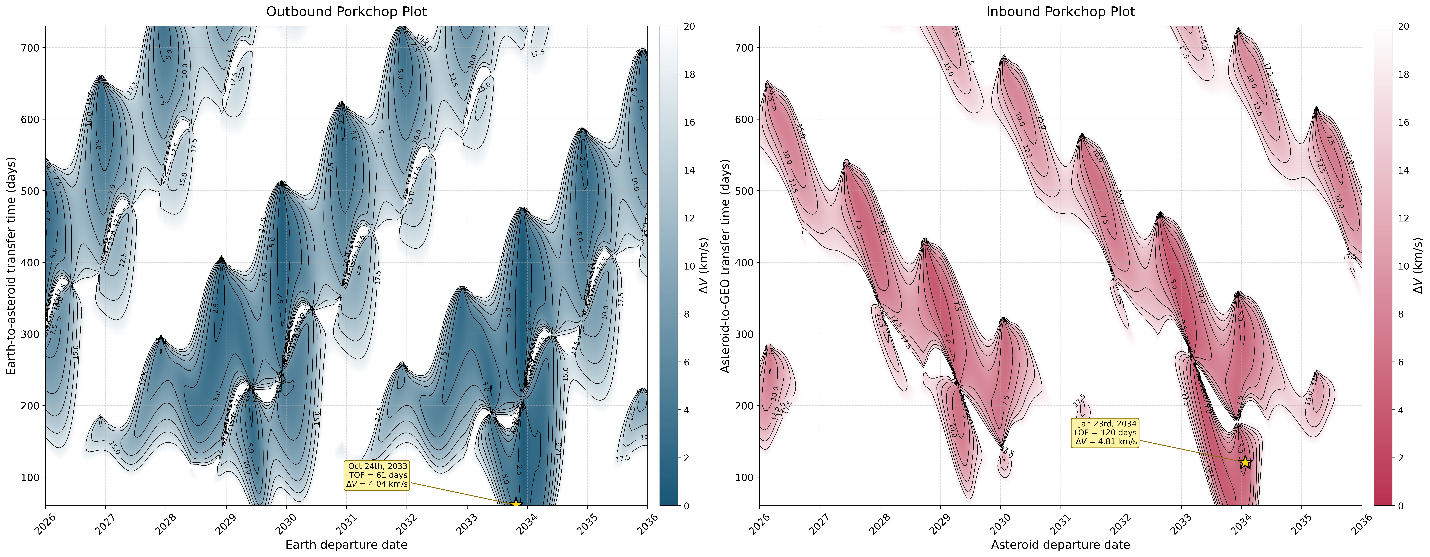
Independent MOPSO comparison of the Pareto structure; pork-chop maps for transfer-window consistency; 2,000 Monte Carlo samples per economic driver.
Mass accounting
Emplaced mining equipment stays at the asteroid. Part of the extracted water supplies return propellant; the remaining product is delivered to a GEO logistics node.
Representative Ryugu case · modeled 2033–2034 mission
Spacecraft ΔV
8.85 km/s
Total duration
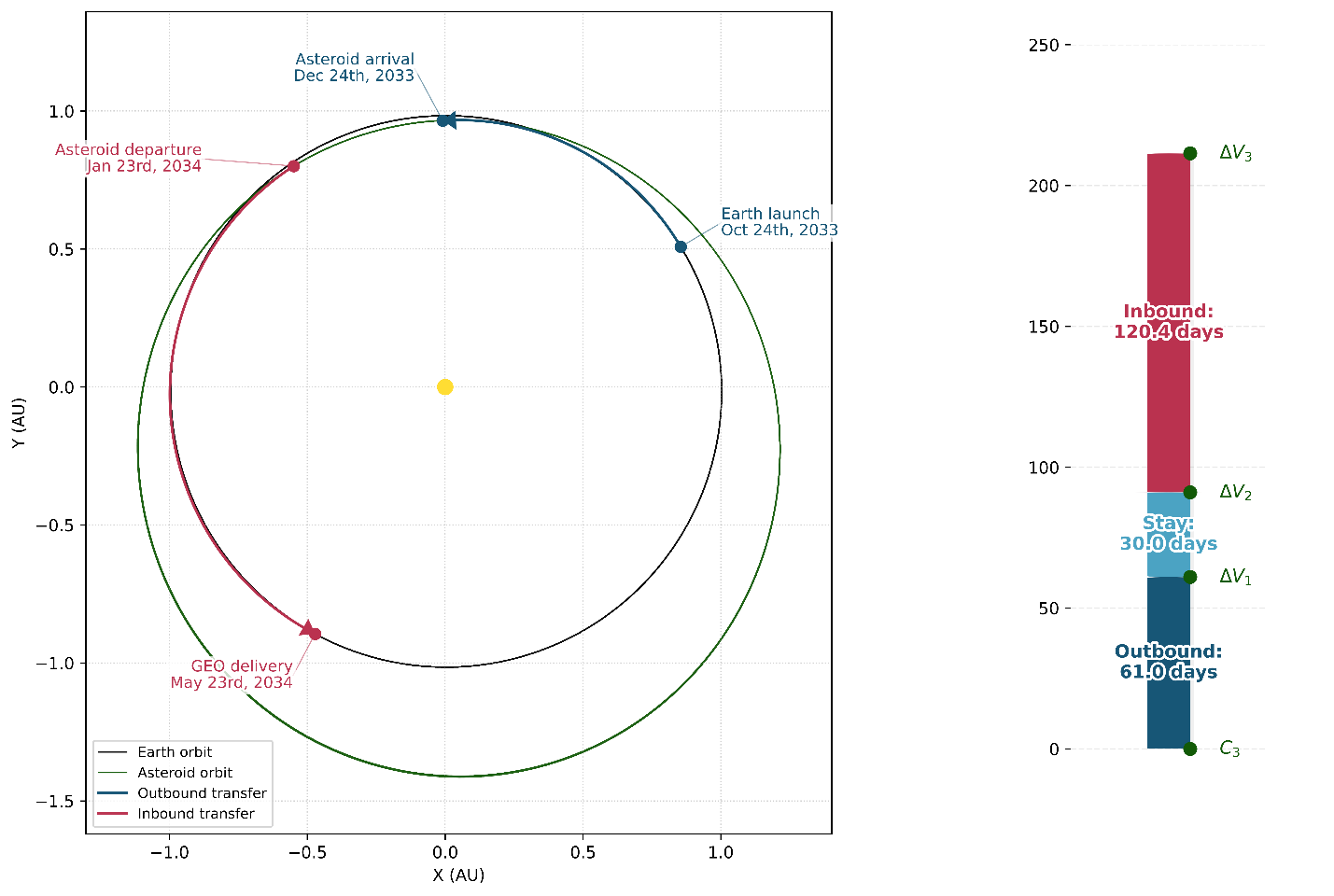
211.4 days
Water delivered to GEO
9,973 kg
Table 5 reports a baseline NPV of $133.53 million in FY 2026 USD. This is a single-sortie result that excludes the separately reported $280 million development cost; it is not a full-program investment return.
Enlarge figure ↗Fig. 1 · Mission concept. Water delivery from a near-Earth asteroid to a GEO logistics node, through outbound transfer, extraction and processing, and return delivery.Enlarge figure ↗Fig. 2 · Method. Orbital and compositional screening feeds an NSGA-II optimizer coupled to trajectory, mass-budget, and economic models.Enlarge figure ↗Fig. 4 · Target comparison. Bennu, Ryugu, and 2008 EV5 compared in the same ΔV–duration–NPV objective space under common modeling assumptions.Enlarge figure ↗Fig. 5 · Ryugu trade-offs. The Earth–Ryugu Pareto set and pairwise projections show trade-offs between maneuver cost, mission duration, and economic return.Enlarge figure ↗Fig. 8 · Knee-region selection. Solutions are scored by distance from a reference plane in normalized objective space. The upper 10% defines a compromise region; crowding distance is used to select a representative.Enlarge figure ↗Fig. 9 · Case-study trajectory. A representative 2033–2034 Ryugu mission: 61 days outbound, 30 days at the asteroid, and 120.4 days inbound; 211.4 days in total.Enlarge figure ↗Fig. 10 · Transfer windows. Outbound and inbound pork-chop plots map transfer time against departure date and required ΔV. Markers identify the selected 2033–2034 case-study opportunity.Enlarge figure ↗Fig. 11 · NPV uncertainty. Single-parameter Monte Carlo distributions for the Ryugu case study, with trajectory geometry and maneuver budget held at the baseline values.Enlarge figure ↗Appendix A · Optimizer comparison. Independent NSGA-II and MOPSO runs recover similar dominant Pareto structures under common boundary conditions. Agreement supports consistency of the search results; it does not establish global optimality.Enlarge figure ↗Fig. 12 · Sensitivity. Delivered water mass and GEO selling price dominate the modeled NPV sensitivity, followed by extraction throughput. Bars show the interquartile range; whiskers show the P10–P90 spread.
Scope: early-stage comparison using two-body dynamics, impulsive maneuvers, a simplified GEO insertion model, and assumed extraction and market inputs. GEO phasing, rendezvous, and proximity-operation costs are omitted. Monte Carlo drivers are varied one at a time, so the distributions do not represent joint mission risk.
06
Manuscript in Preparation
IN PREPARATION
Uncertainty-Aware Autonomous Rendezvous and Proximity Operations
Research manuscript in preparation.
Investigates relative guidance, uncertainty propagation, and collision avoidance for autonomous proximity operations. Comparative evaluation is still in progress.
In preparation · No DOI assigned
Draft Abstract
This manuscript in preparation investigates uncertainty-aware autonomous rendezvous and proximity operations for in-space servicing, inspection, refueling, active debris removal, and assembly. It focuses on navigation errors, dynamic uncertainties, and collision safety when approaching uncertain or non-cooperative targets.
The planned study combines relative orbital dynamics, robust guidance, uncertainty propagation, and real-time collision avoidance in a high-fidelity chaser–target simulation. The guidance framework considers keep-out zones, safety constraints, and contingency trajectory corrections, with a conventional nominal rendezvous approach as the comparison baseline.
The evaluation is planned around Monte Carlo simulations varying initial relative states, navigation errors, and maneuver uncertainties. It will assess collision avoidance, propellant consumption, rendezvous duration, and mission completion performance. The manuscript is in preparation, with comparative evaluation still to be completed.
Kerman Regional Water Company · Applied research project
Prepared monthly water-consumption records for four dams (Jiroft, Baft, Sirjan, and Bam); examined seasonality and stationarity.
Compared five forecasting approaches (SARIMA, Prophet, ANN, LSTM, and GRU) using held-out forecasts and MAE, RMSE, and MAPE; selected SARIMA as the most suitable model for the available series.
Developed a desktop forecasting tool with manual entry of monthly values and CSV import, confidence intervals, diagnostic plots, model evaluation, and results export.
2022 KERMAN
R&D Researcher
Pangan Electronic Co. · Industrial instrumentation and automation
Researched technical requirements and performance considerations for industrial measurement and control products.
Analyzed requirements to support product evaluation and refinement.
Wrote operating instructions and technical guides translating instrument specifications into practical guidance for users.
2019–2021 TEHRAN
Scientific Collaborator and Research Assistant
Space Research Laboratory · K. N. Toosi University of Technology
Investigated asteroid-resource missions, orbital mechanics, lunar-resource economics, GEO refueling, satellite constellations, and space sustainability.
Modeled trajectories, orbital transfers, constellation coverage, and spacecraft design trade-offs using MATLAB, Python, and STK.
Contributed to peer-reviewed journal papers and national spacecraft design competitions.
M.Sc. in Aerospace Engineering (Space Engineering)
K. N. Toosi University of Technology
Thesis supervisor: Mahdi Jafari-Nadoushan
Thesis: Technical, Economic, and Legal Modeling of the Exploitation of Mineral Resources of Near-Earth Asteroids (2021).
مدلسازی فنی، اقتصادی و حقوقی بهرهبرداری از منابع معدنی سیارکهای نزدیک زمین
Research summary
Modeled Earth–asteroid round trips to Ryugu, Itokawa, and Bennu using heliocentric Lambert transfers and an impulsive-propulsion approximation. NSGA-II explored two-objective (ΔV and duration) and three-objective (ΔV, duration, and modeled mission profit) trade spaces; Pareto fronts were analyzed and selected minimum-ΔV solutions checked against published references. A separate legal chapter reviewed international treaties, national resource laws, and possible governance approaches. The economic results are scenario-dependent, and the thesis identifies uncertain target composition as a reason for further characterization before investment decisions.
Conceptual mission feasibility under simplified trajectory and resource assumptions
Coursework: Advanced Orbital Mechanics; Spacecraft Dynamics and Control; Space Mission Design; Space Systems Design.
2014–2018 KERMAN
B.Sc. in Water Science and Engineering · Hydraulic Structures
Shahid Bahonar University of Kerman
Coursework areas: Numerical methods; fluid mechanics and hydraulics; mechanics of materials and structural analysis; remote sensing; engineering economics.
Awards & Projects
Competition achievements and academic projects
1ST PLACE · CONCEPTUAL DESIGN COMPETITION · 2021
Microsatellite Payload Recovery
RECOVE Team · First place in the 2021 Rahneshan conceptual design competition, organized by Iran’s National Elites Foundation. The team developed an autonomous guided parafoil concept for recovering a microsatellite payload at a designated landing location.
My contribution: Researched and evaluated recovery concepts and contributed to the electrical power subsystem as part of the RECOVE team’s autonomous guided parafoil project.
Design Approach
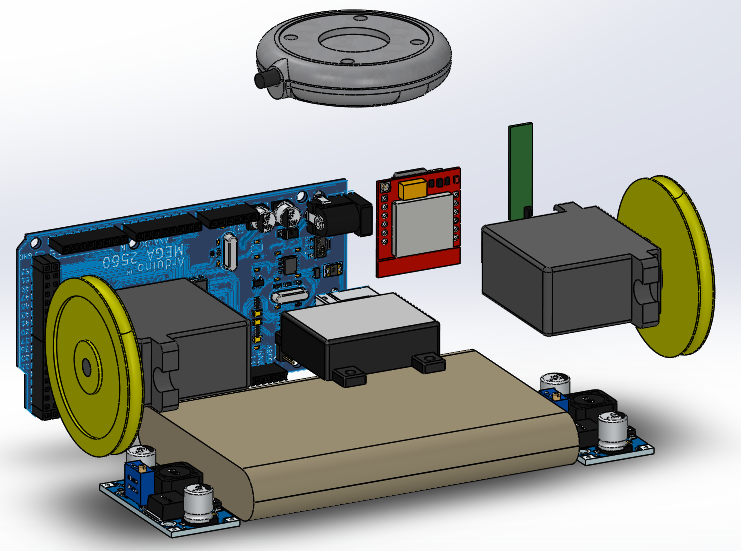
Modular architecture using commercial off-the-shelf (COTS) components, with hardware selection and placement constrained by mass, volume, operating environment, landing accuracy, and cost.
Modeling & Simulation
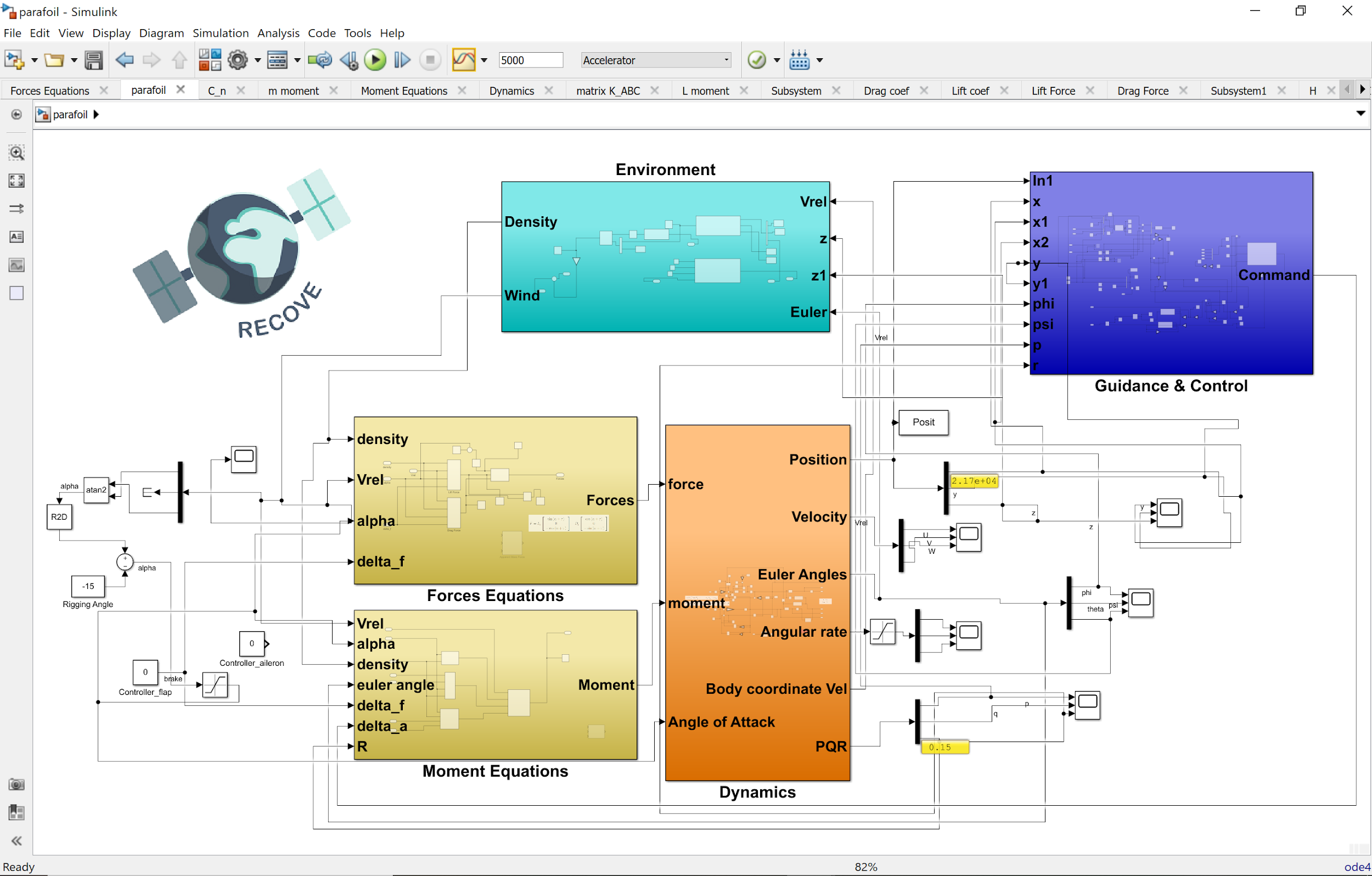
The team’s work included airfoil and aerodynamic analysis, six-degree-of-freedom modeling with disturbances, and autonomous guidance and control simulation. The Simulink model connected environmental inputs, force and moment equations, flight dynamics, and guidance commands.
Verification Planning
Simulation and reliability assessment were considered alongside a test and verification plan, applicable standards, estimated manufacturing costs, and a proposed build schedule.
Swipe to browse · Select a figure to enlarge
Recovery system architectureFunctional overview redrawn from the team’s original design. View full-size diagram ↗Hardware layoutOriginal CAD assembly of the recovery electronics and actuation hardware. Select to enlarge.Flight simulation modelOriginal Simulink model from the IAC presentation. Select to inspect the full-resolution diagram.
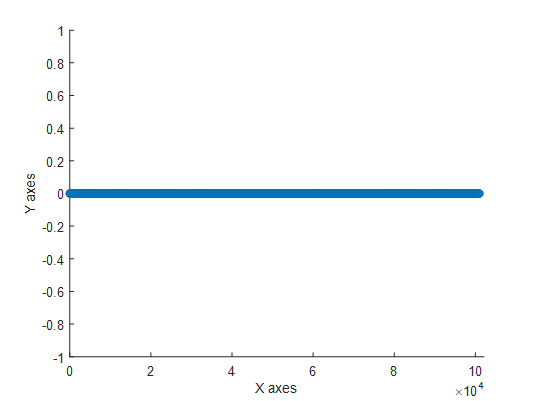
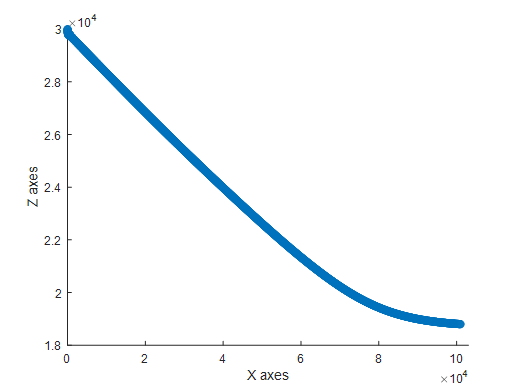
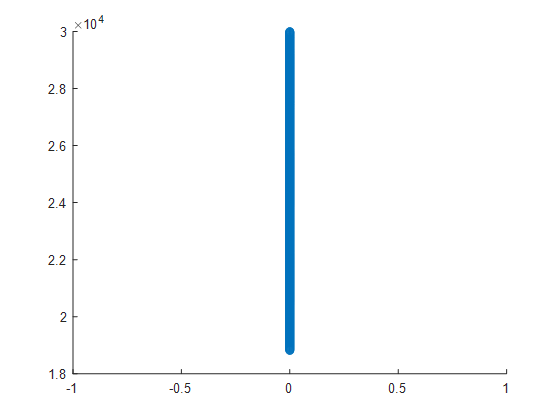
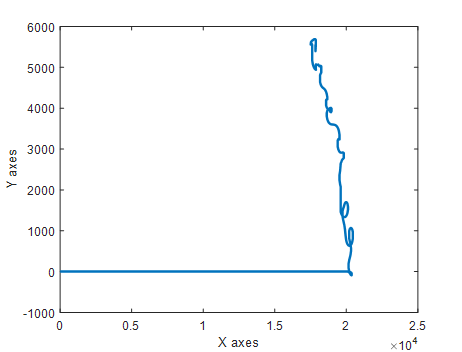
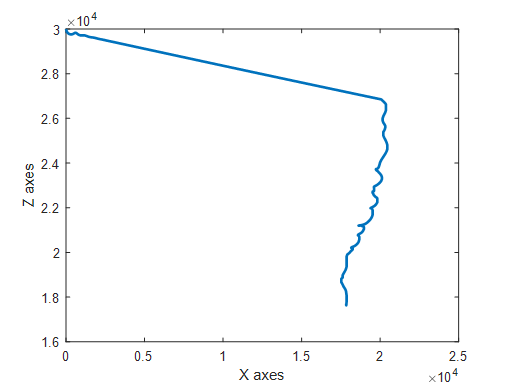
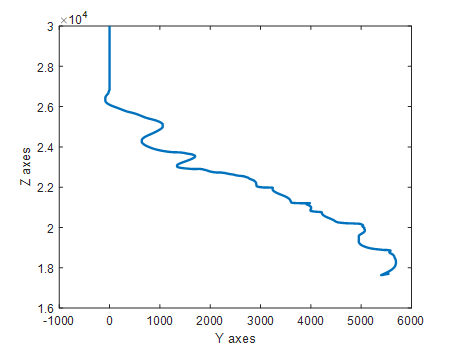
Simulation Trajectories
Simulated trajectories projected onto the X–Y, X–Z, and Y–Z planes. Figures are reproduced from the team’s IAC 2021 presentation in their original row order.
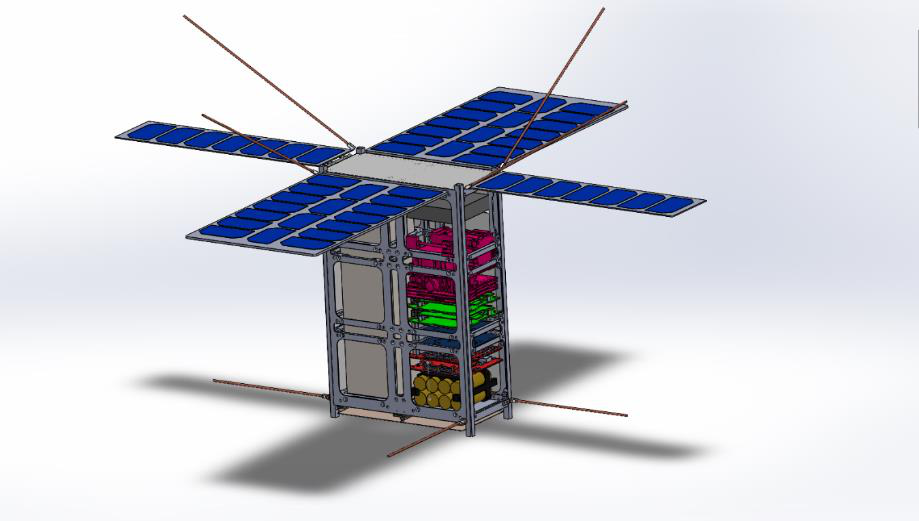
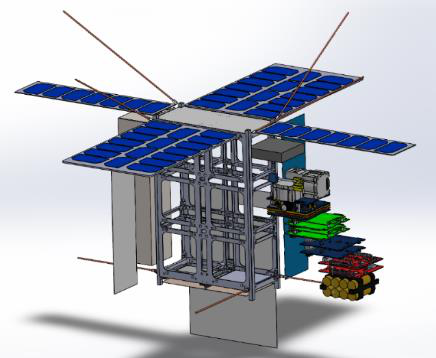
SRL-Sat Team · Recognized as the top team in the conceptual design stage (Phase I) of the scientific and industrial CubeSat design and manufacturing competition, qualifying for the simulation stage.
The three-month system design study developed the mission concept, low Earth orbit and ground station access analyses, spacecraft architecture, subsystem interfaces, a three-dimensional configuration, and an engineering plan for integration and manufacturing.
My contribution: Designed the power distribution architecture and voltage interfaces required to supply the spacecraft’s subsystems. Held responsibility for the electrical power group and contributed to thermal control design.
01
Mission
Communications CubeSat operating in low Earth orbit with a defined link to the ground segment.
02
Spacecraft
6U bus with deployable solar arrays and antennas, payload, radiator panel, and internally packaged subsystem stack.
03
Engineering
Requirements, functional architecture, mass and volume budgets, subsystem interfaces, and configuration validation.
The design provides regulated 3.3 V, 5 V, and 12 V buses, together with an unregulated 8.3 V line, to accommodate the voltage requirements of individual subsystem loads.
Power & Thermal Interfaces
The distribution design includes thermal sensors on the 3.3 V bus and a battery heater on the unregulated 8.3 V line. The spacecraft layout also incorporates a radiator panel.
Subsystem Integration
Power interfaces cover attitude control, onboard data handling, communications, thermal control, and deployment mechanisms. Payload power is allocated according to its requirements.
Swipe to browse · Select a figure to enlarge
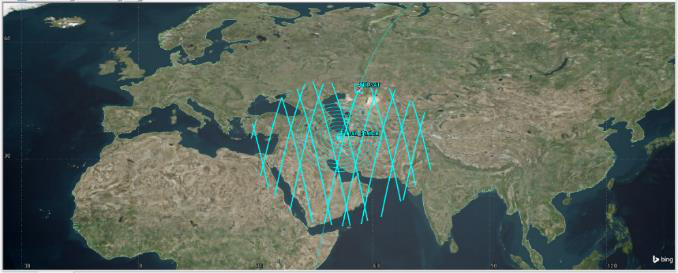
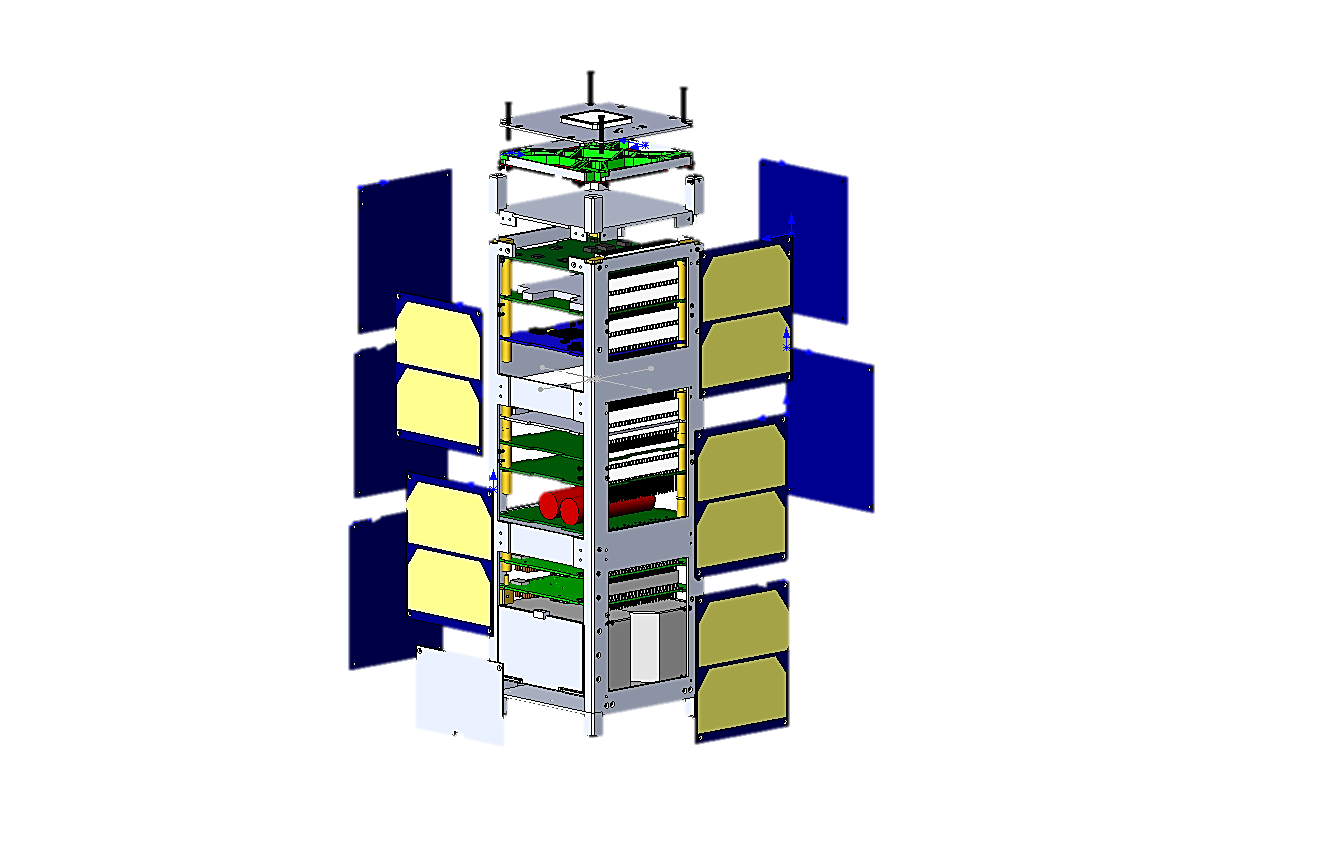
Subsystem arrangementInternal hardware placement within the 6U structure, reproduced from the team’s design report. Select to enlarge.Exploded spacecraft assemblyExploded assembly from the original team report, showing the structural and subsystem arrangement.Mission and access analysisOrbit and ground-access visualization from the project report. Open full image ↗PDU voltage interfacesRecreated from the team’s original diagram. View full-size diagram ↗
3RD PLACE / 2020
Maritime Communications Constellation
TOOSI Constellation Team · Proposed a space-based maritime communications network; awarded third place in a national satellite-constellation design competition organized by the Iranian Space Agency and Kayhan Space Innovation Center.
My contribution: Contributed to CubeSat electrical power design (solar generation, battery storage, power regulation, and distribution) and to business and financial analysis (cash-flow estimates, target-market assessment, and evaluation of commercial feasibility under limited data availability).
Swipe to browse · Select a figure to enlarge
CubeSat designExploded view from the team’s original presentation.Constellation Orbit SimulationSatellite positions and orbital paths around Earth. Open full video ↗Mission architectureRedrawn from the team’s original concept, showing communication links and the data path to users. View full-size diagram ↗
Course Projects
Course: Spacecraft Dynamics and Control
Project: Launch-vehicle guidance implementation and 3-DOF simulation.
Course: Spacecraft Systems Design I–II
Project: LEO remote-sensing mission design; CubeSat attitude control.
Lambert transfers · NSGA-II · PSO/MOPSO · Pareto analysis · Monte Carlo sensitivity analysis · Constellation coverage · ISRU mass budgeting · Numerical optimization · Mission trade studies · Systems engineering
Research Skills
Techno-economic and financial modeling · Academic writing · Technical literature and documentation review · Familiarity with ECSS standards
Documentation & Design Tools
Microsoft Visio · Microsoft Office (Word, Excel, PowerPoint) · EndNote · Adobe Illustrator
Additional Information
Training, service, and qualifications
Technical Training
Spacecraft Relative Motion Kinematics and KineticsUniversity of Colorado Boulder · Coursera · 2025Keplerian and relative-motion models, variational equations, orbital perturbations, and J₂-invariant formations.View credential ↗
STK Certification Level 1Ansys · Issued 7 May 2025Recognizes proficiency in using STK for mission modeling, simulation, analysis, and visualization.Level 1 certification
Space SafetyTechnical University of Munich · Coursera · 2025Space weather, debris and collision avoidance, planetary defense, cybersecurity, and human health in space.View credential ↗
Space Mission Design and OperationsEPFL · edX · 2025Spacecraft subsystems, mission architecture, trajectory planning, operations, risk, and cost considerations.View credential ↗
New Space EconomyEPFL · edX · 2024Commercial space infrastructure, Earth observation, communications, navigation, servicing, governance, and sustainability.View credential ↗
The Science of the Solar SystemCaltech · Coursera · 2024Planetary geology and dynamics, spectroscopy, habitability, and the scientific interpretation of exploration data.View credential ↗
Writing & Computing
Writing in the SciencesStanford University · Coursera · 2025Clarity, scientific-paper structure, self-editing, peer review, and communication for specialist and public audiences.View credential ↗
Data VisualizationUniversity of Illinois Urbana-Champaign · Coursera · 2024Visual encoding and clear graphical communication of complex, comparative, and time-series data.View credential ↗
Programming for EverybodyUniversity of Michigan · Coursera · 2023Python fundamentals, expressions, control flow, functions, iteration, and introductory problem solving.View credential ↗
Persian: Native English: Professional working proficiency.
Book manuscript · Space Mining
Persian-language collaborative volume · in preparation
My writing focuses on draft Chapter 6, Space Law, and Chapter 7, Space Economics. The legal chapter examines current international rules, gaps affecting resource use, and possible elements of a clearer governance framework. The economics chapter connects demand for resources in space with extraction costs, mission feasibility, valuation methods, and illustrative asteroid-mining scenarios.
The wider book is planned to cover candidate celestial bodies, asteroid composition and orbits, surveying and extraction methods, spacecraft systems, trajectory design, and the history and future of resource missions. These topics describe the volume’s scope; my stated contribution is the legal and economic writing.
Academic Service
Peer review: Reviewed one manuscript for Acta Astronautica.
Elsevier reviewer recognition · September 2026
Conference service: Executive staff, 14th National Conference on Irrigation and Evaporation Reduction.
Personal Interests
Swimming, mixed martial arts, reading, music, and strategy games.
Open to PhD opportunities and research collaboration.
“Nor you nor I can read the etern decree,
To that enigma we can find no key;
They talk of you and me behind the veil,
But, if that veil be lifted, where are we?”